How to maintain a taper fade between cuts
Hair grows about 1.25 centimetres a month, which is roughly 0.4 millimetres a day. Because your taper started at zero or close to it, that daily fraction is a large proportional change. Understanding which part fails first is most of what you need to keep the cut looking intentional.
A taper does not degrade evenly. It fails in a predictable order, and once you know the order you can decide what is worth doing at home and what is worth waiting for.
What fails first
- The neckline, within a week. Hair grows below the line that was cut, so the edge goes from crisp to fuzzy faster than anything else.
- The sideburn edge, around week two. Same reason. It is a defined line, and the definition is the first casualty.
- The shortest point of the taper, weeks two to three. Skin becomes stubble, stubble becomes a length. The contrast that made the cut read as a taper flattens out.
- The blend, weeks three to four. As the short area grows and the kept area grows, the boundary between them stops being gradual.
- The top, weeks five and beyond. Last to matter, because a proportional change on four inches of hair is barely visible.
Two useful conclusions. The parts that fail first are edges, which are the easiest things to maintain. And the part most people worry about, the length on top, is the least urgent.
What you can safely do at home
There is a real line between tidying and cutting. Stay on the tidying side and you can add a week or two without risk.
The neck, below the natural hairline
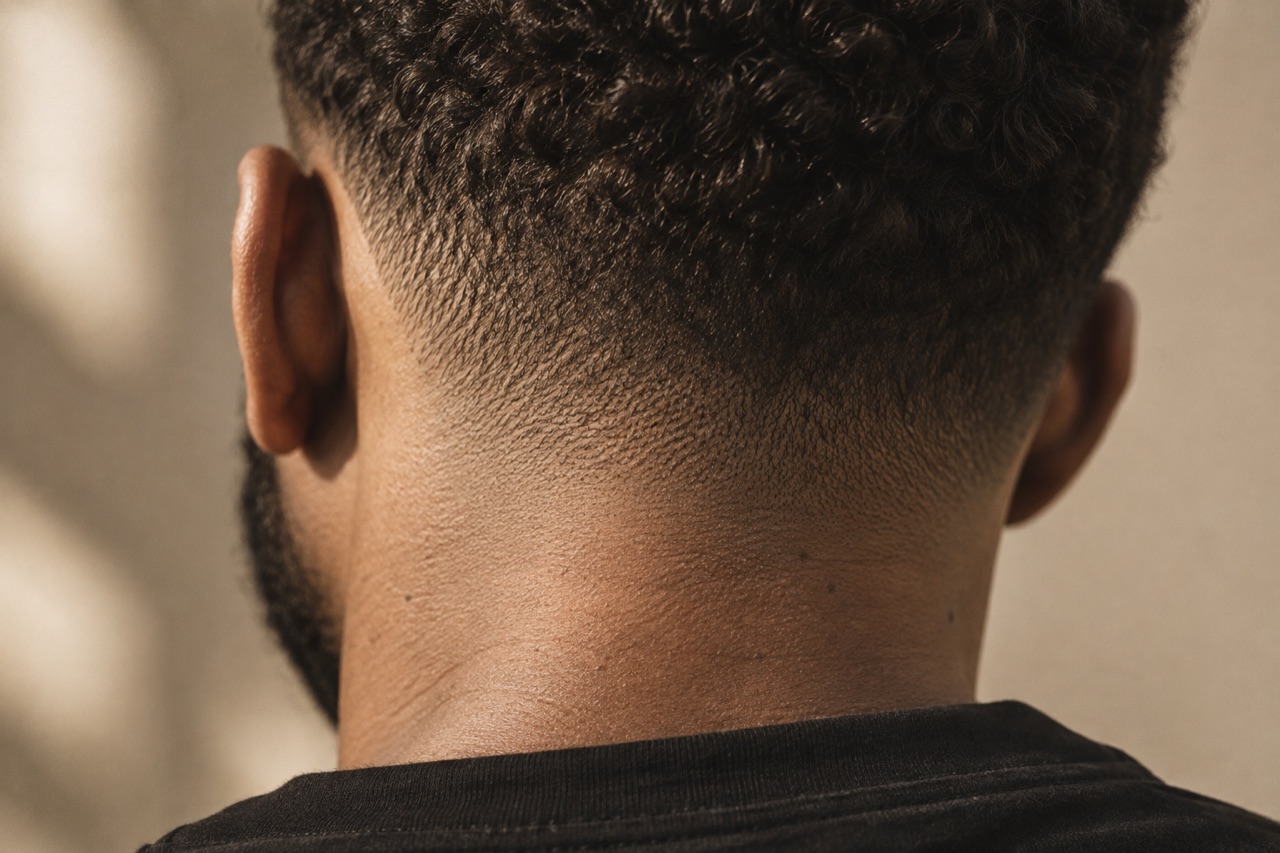
The stray hair that grows on your neck below where your hairline naturally sits is safe to remove. It is not part of the haircut. Use a trimmer with no guard, or a safety razor, and work only on the area clearly below the line your barber left.
Around the ears
Fine hair that grows onto the top of the ear or into the groove behind it can be trimmed. Use a small trimmer, go slowly, and only remove what is obviously outside the shape.
Washing and product
A tapered perimeter looks best when the hair above it lies down rather than projecting. As the cut grows, weight builds and the hair starts to stand away from the head. Product is the honest fix here, and a matte clay or paste does more for a three week old taper than any trimming will.
What to leave alone
- The blend. Fading is the hardest thing a barber does. Attempting it at home with one or two guards produces stripes, and stripes are more visible than soft regrowth.
- The taper height. Re-establishing the short band means deciding where it starts, and getting that wrong is a month long mistake.
- The sideburn line. Easy to take too much, and asymmetry between the two sides is obvious to everyone but you.
- Anything on top with clippers. Clipper work on the top of a head with any length is very hard to do without leaving tracks.
Stretching the cycle
If you want longer between appointments, the decisions that matter happen in the chair, not afterwards.
| Choice | Effect on the cycle |
|---|---|
| Finish on a #1 instead of skin | Roughly triples how long the edge looks clean |
| Ask for a lower taper | Less gap between kept and short hair, so it softens rather than breaking |
| Ask for a longer blend zone | The boundary has further to travel before it reads as a line |
| Ask for a tapered neckline | Grows out soft instead of forming a shelf |
| Have weight removed above the taper | The sides lie down for longer as they grow |
Stack all five and a taper that would have needed attention at two weeks will hold for six. The trade-off is honest: it will never look as sharp on day one as a high skin taper does. You are choosing average appearance over peak appearance, which for most people is the better deal.
A realistic schedule
For a mid taper finishing on a #1, which is the most common combination:
| Week | State | Do |
|---|---|---|
| 1 | Sharp | Nothing. |
| 2 | Neck is fuzzy | Clean below the neckline only. |
| 3 | Edges softening, sides building | Clean the neck and ears. Start using product. |
| 4 | Blend flattening out | Product daily. Book the next appointment. |
| 5 | Reads as grown-in rather than cut | Get it cut. |
| 6 | Shape is gone | Overdue. |
Shift that table earlier by roughly two weeks for a skin finish, and later by a week for a low taper on a #2. There is nothing precise about it. Growth rates vary between people by a meaningful margin, and hair-to-skin contrast changes how visible any given stage is.
Tools worth owning
You need very little, and buying a full clipper set usually leads to attempting things you should not.
- A small trimmer with a narrow blade. For the neck and around the ears. This is the only cutting tool most people need.
- A hand mirror. Genuinely the highest value item on this list. You cannot maintain what you cannot see.
- A matte clay or paste. For controlling side weight in weeks three onward.
- Nothing else. Guards, fading combs and shears are for people who have been taught to use them.
If you do decide to maintain the taper itself at home, be realistic that the first few attempts will look worse than the regrowth would have. That is a fair price if you want to learn, and a bad one if you just want to look tidy this week.
Common questions
How often should you get a taper fade?
It depends on the finish. A skin finish realistically needs attention every two weeks, a shadow finish every three to four, and a taper finishing on a #1 guard every five to six.
Can I clean up my own neckline?
You can safely remove the stray hair that grows below your natural hairline. Never raise the neckline itself, because chasing a straight edge upward permanently moves your hairline until it grows back.
How do I make a taper fade last longer?
Finish on a #1 guard rather than skin, choose a lower height, ask for a longer blend zone and a tapered neckline, and have weight removed above the taper. Together those changes can take a two week cut to six weeks.
Should I try fading my own hair at home?
Blending is the hardest part of the cut and the easiest to get visibly wrong. Cleaning the neck and around the ears is low risk. Re-fading the blend yourself usually looks worse than letting it grow.
Keep reading
All guidesThe taper fade, from the chair
What a taper fade actually is, how high it can sit, how short it can finish, and how to pick the version that suits your hair and your schedule.
Haircut numbers: clipper guards in millimetres
Haircut numbers explained. Every clipper guard from #0 to #8 with its length in millimetres and inches, and where each one belongs on a head.

The low taper fade
A low taper starts at the earlobe and keeps almost all your side weight. Here is how short it can finish, who it suits, and why it is the easiest fade to live with.